L'isolation thermique
Thermal insulation, R-values, insulation materials, external thermal insulation (ETI) and internal thermal insulation (ITI).


Summary for decision-makers
Atelier Muses, a ceramics studio founded by Loélia Casas Flores in the South of France, has expanded its work to include murals. Each composition assembles hand-shaped clay pieces, either unique or in small series, whose textures capture the light and cause the design to change throughout the day. The repertoire is Mediterranean: birds, plants, celestial bodies, and undulating lines. Dimensions, motifs, and composition can be customized for individuals, architects, or interior designers.
The wall remains the largest surface in an interior, and the most often treated flat. Hand-modeled ceramics offer another avenue: a relief decoration, whose shadows shift with the daylight. Atelier Muses has made this its new scale of work.
A painted or wallpapered wall presents itself at a glance. It looks the same in the morning and evening, and the eye eventually stops noticing it. A textured surface behaves differently: the volumes catch the light, and the shadows they cast shift throughout the day. The same wall is not perceived in the same way at midday and in the late afternoon.
This is precisely what Atelier Muses aims for with its ceramic wall murals. "The reliefs create shadows, the patterns evolve throughout the day, and the mural seems almost alive," explains Loélia Casas Flores, the ceramicist who crafts them in her studio in the South of France. For anyone considering installing one in their home, the chosen location is just as important as the design itself: it's the light that brings the reliefs to life. This highlights the appeal of merging materials and decorative elements in an interior, rather than a uniform covering from one wall to the next.
An Atelier Muses mural is not a single, decorated plaque. It is made of ceramic pieces, each individually hand-modeled and then assembled to form a composition. The wall thus retains the regular grid of the tiles, on which the raised motifs flow freely from one piece to the next.
The workshop gradually took shape on the wall. Loélia Casas Flores initially worked with objects: vases, bowls, sculptural pieces. The ceramics then changed scale, eventually leaving the table to adorn the walls and becoming a composition capable, on its own, of defining an interior.
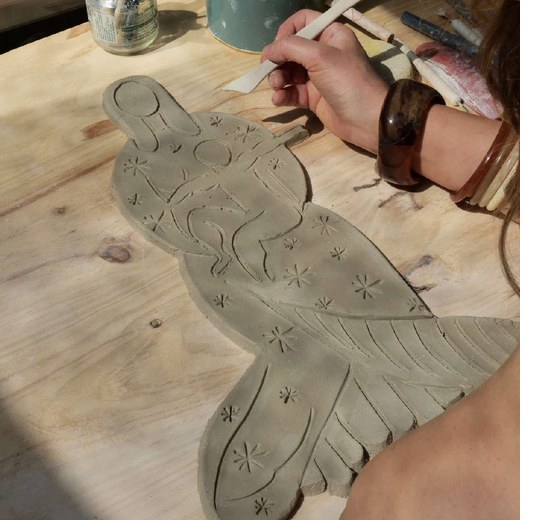 This is the main difference compared to a commercially available decorative panel. An industrial product repeats its motif identically, from one copy to the next and across the entire surface. Here, each element bears the mark of the hand that shaped it. The workshop does not strive for industrial perfection: it embraces the traces of the hand, the irregularities of the material, and the unique character of each piece.
The consequence is tangible. The murals are produced as unique pieces or in small series, and no two compositions are ever exactly alike. What would be considered a flaw in a mass-produced item is, here, precisely what one is buying.
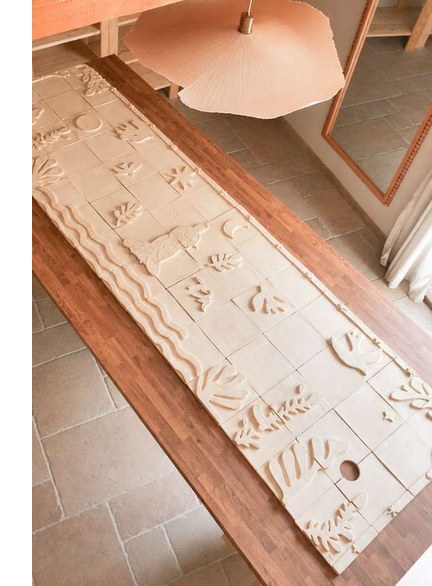 The repertoire of motifs comes from the Mediterranean, which permeates all the work of the studio: its colors, its light, its birds, its plants, its irregular lines. One finds birds in motion, plant forms, stylized flowers, abstract silhouettes, marine motifs, celestial bodies, and long, undulating lines. Loélia Casas Flores also claims the legacy of artists from the South and cites the free and organic world of Matisse.
The result is a blend of art, craftsmanship, and decoration. "I want ceramics to transcend their function as objects and become a presence within an interior," says the designer. A mural is therefore not an accessory added to an already finished wall, but rather the element around which the room is organized, just like the materials that give an apartment its character.
There's no obligation to choose from a catalog. Dimensions, patterns, and composition can be designed for a specific project, taking into account the architecture of the space, its lighting, and its atmosphere. The workshop works with individuals as well as architects and interior designers, creating bespoke layouts —even in small apartments , where a single treated wall can transform the room.
Three details are not provided and must be requested directly from the workshop before proceeding: the dimensions of the tiles and the overall composition, how the assembly is fixed to the wall, and the production time. The price is also not displayed.
A series of terracotta tiles assembled on the wall, on which relief motifs stand out: birds, foliage, flowers, celestial bodies, undulating lines. The grid of the tiles remains visible, and the motifs flow freely from one tile to the next. Each element is hand-modeled.
An industrial panel repeats its pattern identically, from one copy to the next. A hand-crafted fresco bears the mark of the hand: contours and thicknesses vary slightly from one piece to another. The workshop embraces these variations instead of trying to erase them.
Yes. The dimensions, patterns, and composition can be tailored to a specific project, taking into account the architecture of the space, its lighting, and its atmosphere. The workshop works with private individuals as well as architects and interior designers.
No, and that's intentional. Since each piece is handcrafted, the irregularities of the material vary from one element to another. The creations are produced as unique pieces or in small series, and each composition is conceived as singular by the workshop.
The workshop doesn't prescribe any particular piece, but provides a useful guideline: it's the shadows cast by the reliefs that bring the composition to life throughout the day. The wall's exposure to light is therefore just as important as the chosen motif.
The workshop does not provide pricing or production time, nor the dimensions of its tiles or the method of wall mounting. These four points should be inquired about directly when the project is taking shape, before any commitment is made.
A material obtained by firing previously shaped clay. The term covers pottery and earthenware as well as tiles and decorative pieces intended for walls.
Decorative composition applied to a wall. At Atelier Muses, it is made up of several pieces of ceramic assembled together and not of a single, single piece.
The thickness given to a motif, which makes it stand out from the plane. Relief creates cast shadows: these vary according to the direction of the light and the time of day.
An object made in a single copy, not reproduced identically. It is the opposite of mass production, where each copy is intended to look exactly like the others.
Production of a limited number of copies of the same model. Handcrafted, these copies remain similar without being strictly identical to each other.
A creation defined for a given project, here based on the dimensions of the wall, the architecture, the light and the atmosphere of the place that will host the work.
2 Avenue du Souleilla
31320 Vigoulet-Auzil
France


